Getting started
eventcatalog@2.6.0The OpenAPI specification is a widely-adopted standard for defining and describing RESTful APIs in a structured, machine-readable format. It provides a way to document APIs, including the endpoints, parameters, request and response formats, authentication methods, and more, making it easier for both humans and machines to understand and interact with the API.
Using the EventCatalog OpenAPI generator you can automate and generate your EventCatalog.
Want to see what your OpenAPI file looks like in EventCatalog? Try the playground — drop your file and see the result in seconds.
Core Features
The EventCatalog OpenAPI plugin can provide you with many features:
- ⭐️ Generate domains, services and messages into your catalog from your OpenAPI specification files
- ⭐️ Assign owners (your teams) to your services and messages all generated by your OpenAPI files
- ⭐️ Automate your EventCatalog and fetch OpenAPI files by URL
- ⭐️ Map commands, queries and events from your OpenAPI file using custom extensions
- ⭐️ Add semantic meaning to your OpenAPI files, persist this meaning between versions
- ⭐️ Automatically version your changes in EventCatalog in sync with your OpenAPI versions
- ⭐️ Render and display your OpenAPI specification in EventCatalog
- ⭐️ Display your endpoints and parameters in the catalog
- ⭐️ Ability to download your schemas and OpenAPI files (also versioned)
- ⭐️ Ability to draft services and endpoints in EventCatalog from your OpenAPI files
- ⭐️ and more....
How it works
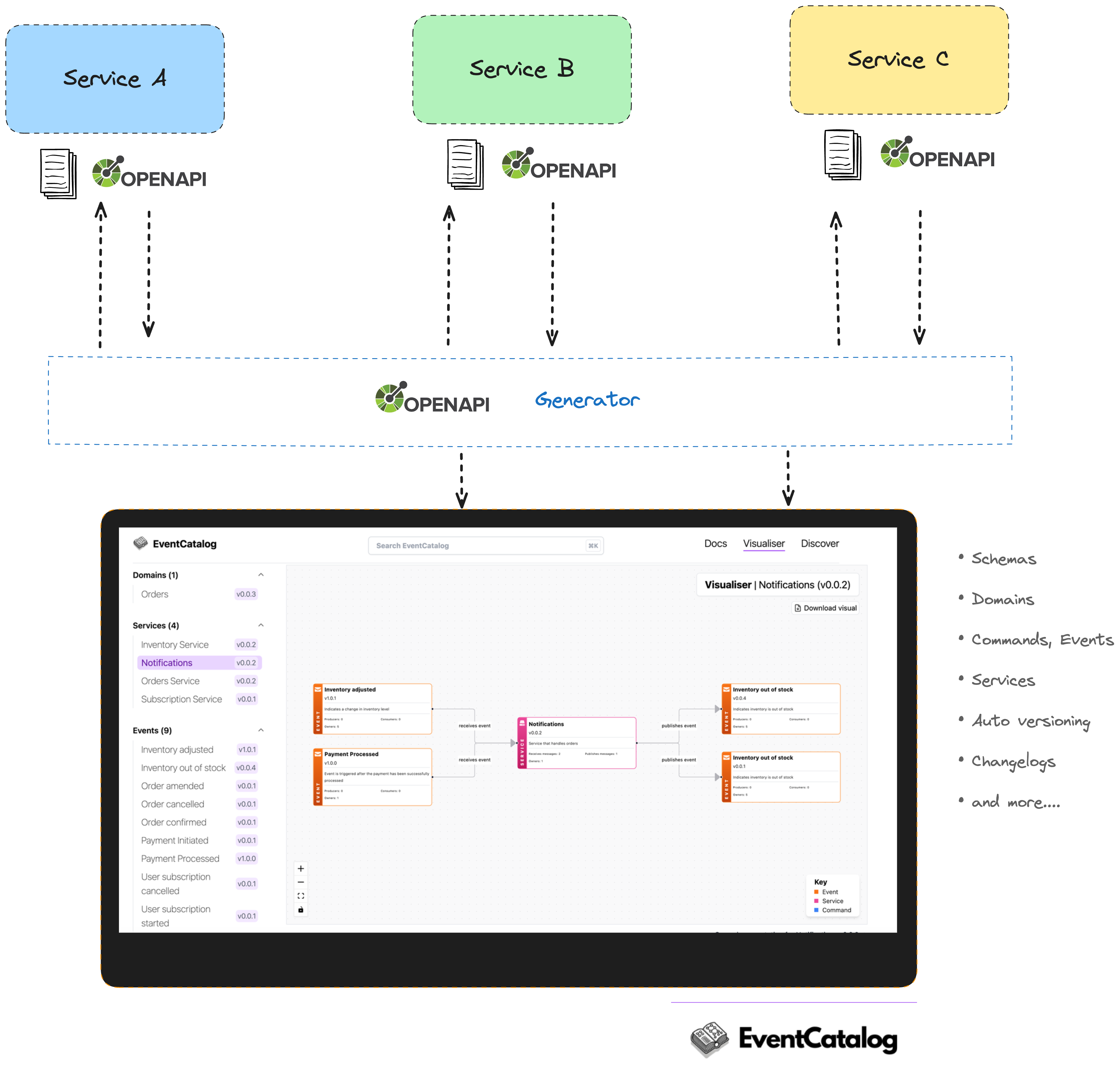
EventCatalog supports generators. These are scripts or plugins that can be run to integrate with any external API, system or specification files. EventCatalog also provides an SDK to give developers easier access to their catalogs through custom scripts or generators.
The EventCatalog OpenAPI plugin let's you define 1 or many OpenAPI files. When running the generate command the scripts populate your EventCatalog. You can choose how your OpenAPI services are added to EventCatalog and which domain they belong to.