






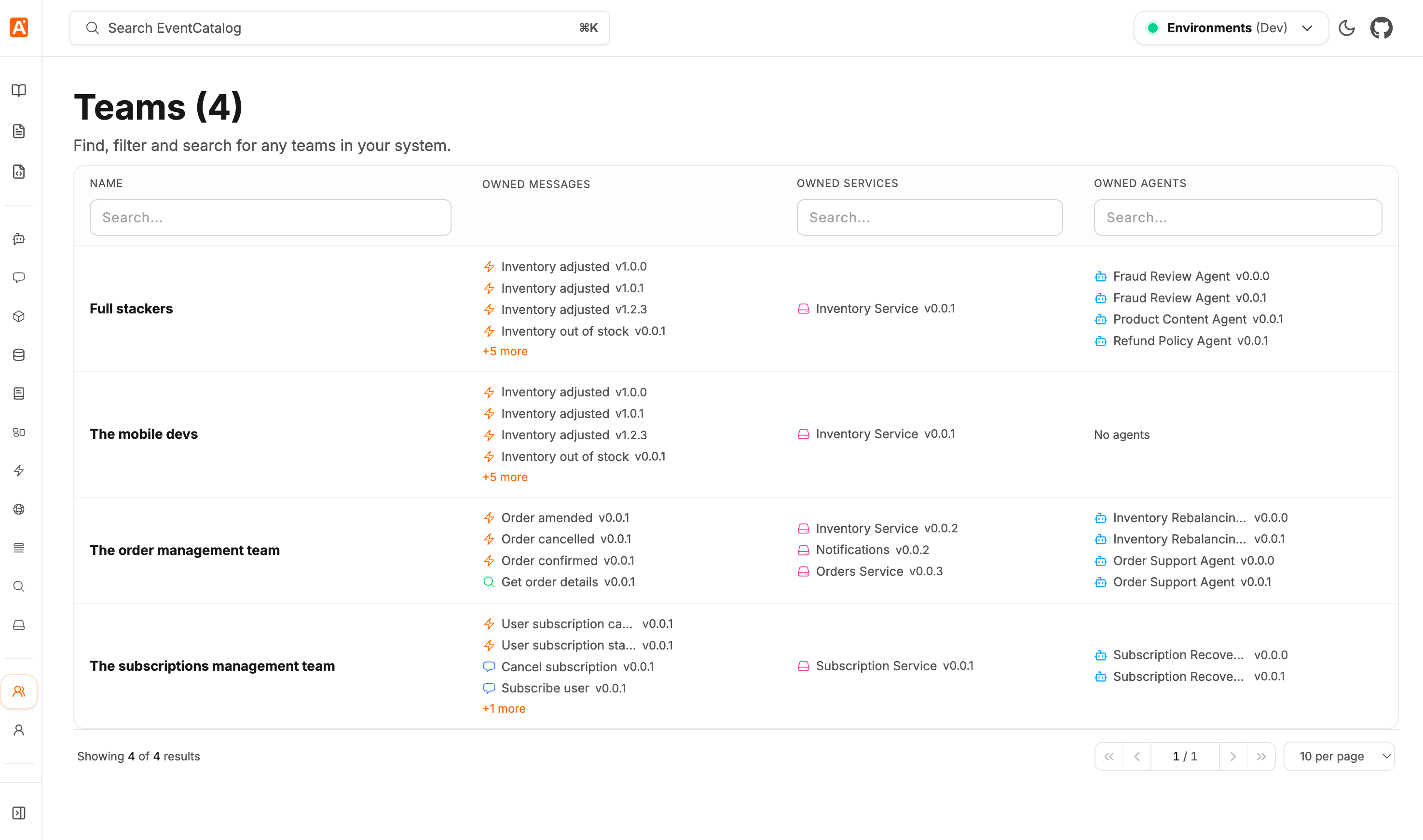

Software primitives
Model architecture as architecture
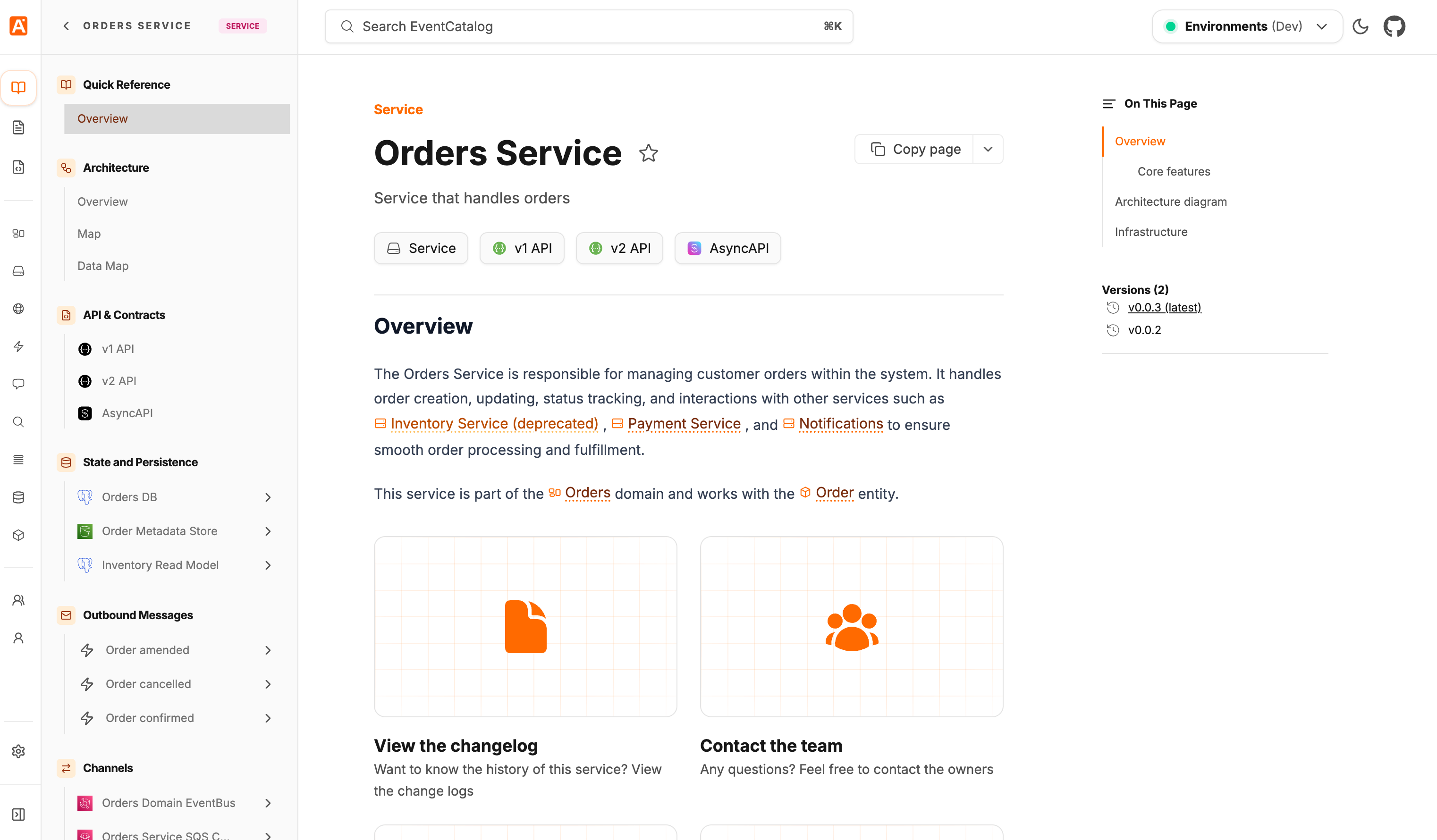
Treat domains, services, messages, schemas, teams, and flows as first-class resources instead of burying them inside pages, diagrams, and scattered markdown.
Document, govern, and discover your services, domains, APIs, and events in one place.
EventCatalog helps you document your architecture for engineers and AI

One place for your domains, services, messages, and schemas. So your team and AI agents can find what exists, who owns it, and how it connects.
Store documentation in your Git repository. Version controlled and developer-friendly.

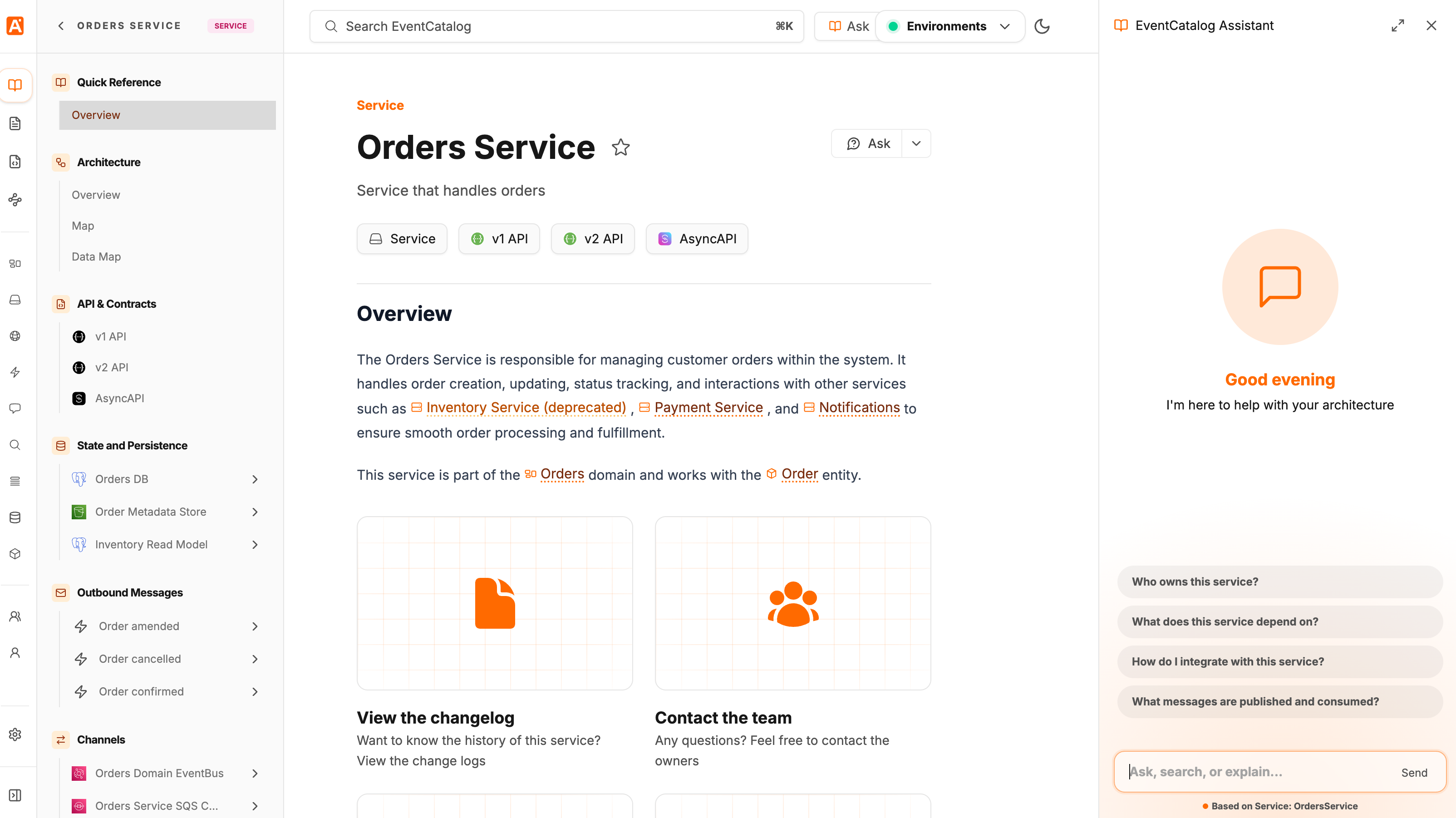
Ask about your architecture in plain English. Get accurate answers instantly.

Store documentation in your Git repository. Version controlled and developer-friendly.

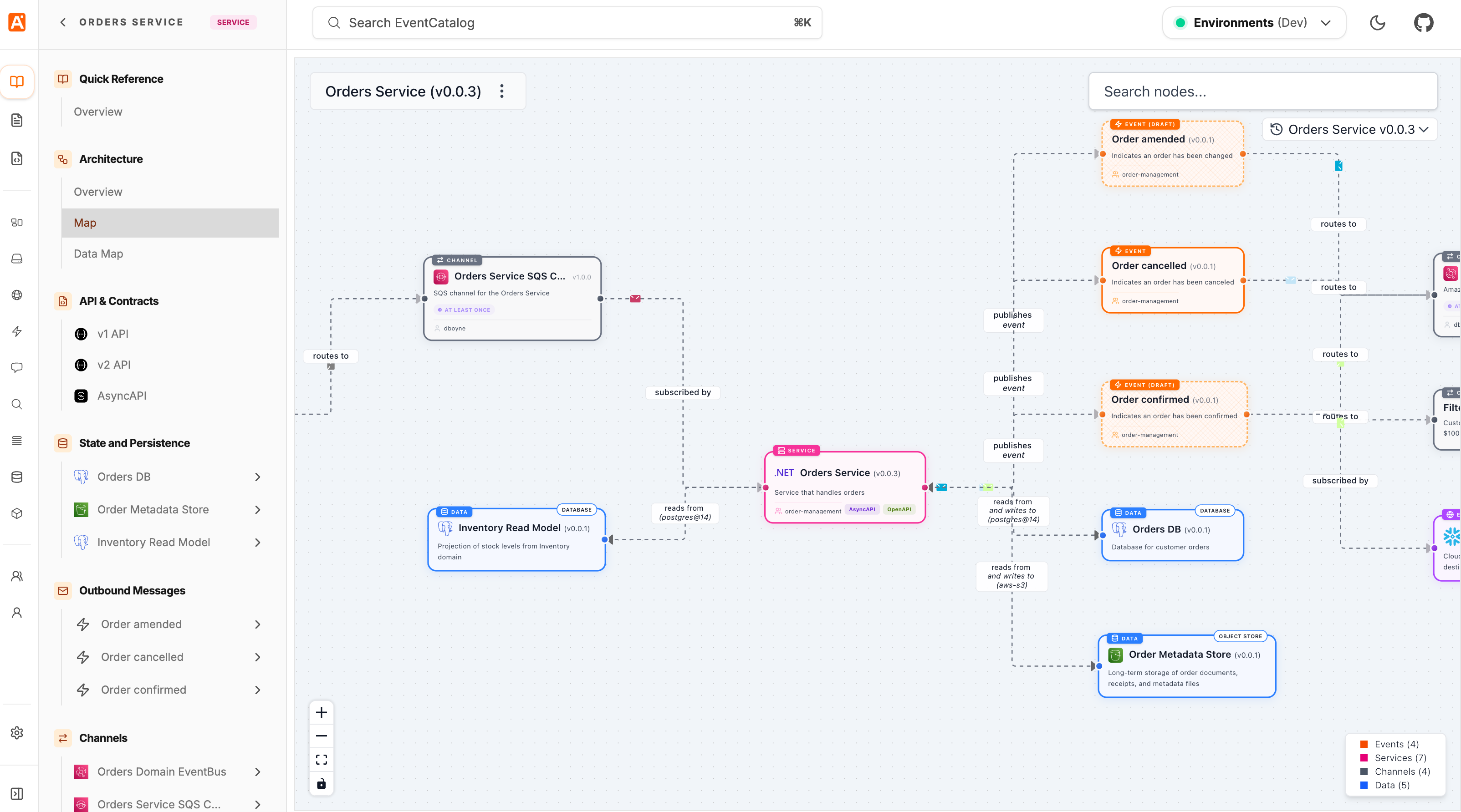
EventCatalog will visualize your domains, services and messages.

Ask about your architecture in plain English. Get accurate answers instantly.


“With EventCatalog we now have a clear view of all events and schemas, and we know who to reach out to when we want to consume data.”
Dennis Baerten/Freelance Lead Engineer, Nike
EventCatalog is not a general documentation tool. It is built around software primitives, domain-driven design practices, and technology-agnostic models for any architecture.
Software primitives
Treat domains, services, messages, schemas, teams, and flows as first-class resources instead of burying them inside pages, diagrams, and scattered markdown.

DDD and technology agnostic
Capture bounded contexts, ubiquitous language, ownership, and relationships across whatever stack your organization uses today or adopts next.
Architecture context for AI
Give engineers and AI agents the same structured architecture context: domains, services, events, schemas, owners, and flows.
Self-hosted and secure by default. Your architecture, your queries, your AI context all stay on your infrastructure.
Ask Cursor “what services consume OrderCreated?” and get a real answer. Works with Claude, VS Code, Windsurf, or any MCP-compatible tool.
You own your models and your data. Connect OpenAI, Anthropic, or any LLM. Your architecture context stays private.
Every build produces an llms.txt file so any AI agent can discover your architecture without custom integrations.
Connected automation
Use OpenAPI, AsyncAPI, and schema registries to generate catalog resources automatically. Teams keep the context, ownership, and language that automation cannot.
OpenAPI, AsyncAPI, registries.
Schemas change, docs update.
Run locally or in CI/CD.
Connect internal systems.
Connect to your stack
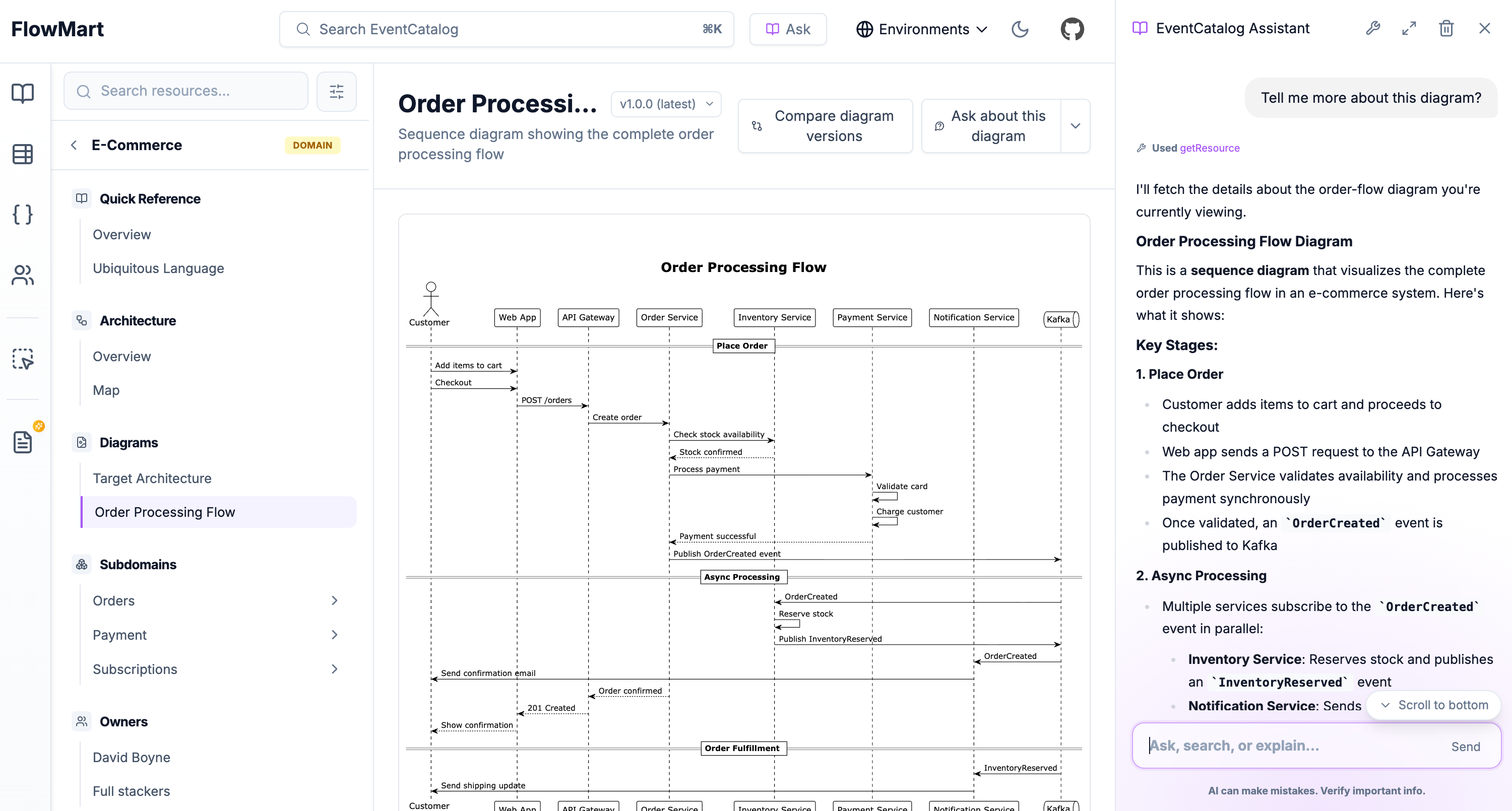
Bring your existing architecture diagrams into EventCatalog and treat them as first-class architectural knowledge.
We don't replace your tools. We connect them.
See how diagrams looked last quarter, last year, or before the migration. Every version is preserved alongside the docs that explain them.
Your diagrams live in your repository. No vendor lock-in, no external dependencies. Perfect for regulated industries.
Diagrams are indexed alongside your architecture. Find flows, dependencies, and system views when you need them, not buried in a wiki or slide deck.
Because diagrams are linked to real architectural resources, AI tools can explain flows, dependencies, and responsibilities, not just render images.

Trigger catalog builds from any CI/CD pipeline: GitHub Actions, GitLab CI, Jenkins, or anything else. Teams update schemas in their own repos, and the catalog rebuilds automatically.
feat: add OrderCreated event schema
docs: update PaymentService API
fix: correct StockUpdated schema
Merge: Build unified catalog
catalog.yourcompany.com updated
3 services, 12 events, 4 schemas
Works with any CI/CD
GitHub, GitLab, Jenkins, and more
Teams update specs and schemas in their own repos. The catalog picks up changes on the next build. No central bottleneck.
GitHub Actions, GitLab CI, Jenkins, or any CI/CD tool. EventCatalog integrates without dictating how you deploy.
Rebuild documentation on schema changes, merges, releases, or on demand. You control when and how architectural changes become visible.
EventCatalog doesn't impose a workflow. It reflects the ones you already have.
Loved by architects and engineers
Trusted by engineers and architects building complex systems.
EventCatalog has been a game-changer for how we think about and communicate our architecture. Within days of adopting it, our entire system became something anyone on the team could actually understand and reason about. It's the rare tool that's a joy to use.

As a team working with DDD and Event-Driven Architecture, keeping everyone aligned on domains, services and message contracts is a real challenge. EventCatalog tackles this head-on. We use it both as a company-wide architectural overview and as living documentation generated directly from our code. It is one of those rare tools that genuinely fits how we think about software.

At my current project we have a large event-driven architecture setup with more than 100 events across different domains owned by multiple teams. With EventCatalog we now have a clear view of all events and schemas — and more importantly, we know who to reach out to when we want to consume data.

EventCatalog, together with AsyncAPI and other specs, makes sure your architecture stays controlled, preventing it from spiraling into chaos.

Creating easy to maintain and easy to consume API and event documentation that is always up to date has been one of the most consistent challenges of my career. EventCatalog has become the keystone tool to finally make it possible.

EventCatalog is my go to solution when I introduce event-driven architecture to an audience.

EventCatalog helps to bridge the gap between a PO's business view and an Engineer's technical view.

Start building
Docs-as-code for architecture. Open source, self-hosted, and no lock-in.
npx @eventcatalog/create-eventcatalog@latest my-catalog